
When a ceiling stain shows up next to a chimney, many people blame the chimney itself. Very often the real culprit is the flashing, the strips of metal that seal the joint between the chimney and the roof. It is one of the most common leak sources we find on homes in Rancho Palos Verdes and the beach cities, and one of the most misdiagnosed. Below are five signs that your flashing has failed, how to check for each one, and what a proper repair looks like.
How flashing is supposed to work
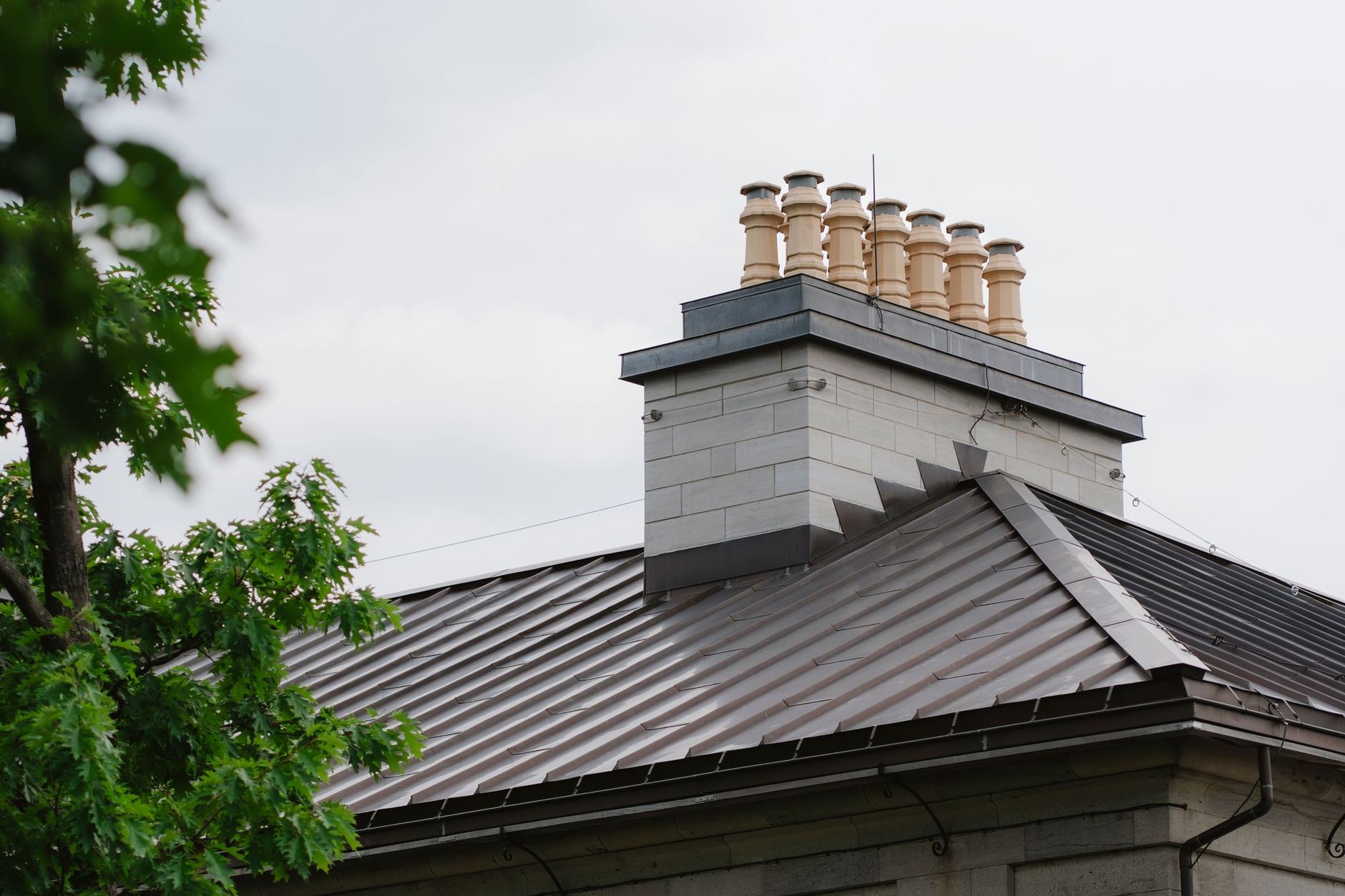
A chimney passes through the roof, and that hole has to be sealed against rain running down the slope. Flashing does it in layers. Along the sides, small L-shaped pieces called step flashing are woven in with each course of shingles or tile. Over the top of those, counter flashing is set into a groove cut in the chimney's mortar joints and bent down to overlap the step flashing. On the uphill side, a wide chimney needs a cricket, a small peaked roof section behind the chimney that splits the water and sends it around the sides. On the downhill side, an apron piece laps over the roofing.
When all of that is done right, water never touches the joint. When any piece fails, water finds the gap.
Sign 1: A stain right beside the chimney, not in the middle of the room
Flashing leaks show up close to the chimney: on the ceiling at the corner where the chimney breast meets it, or high on the wall next to the chimney. They usually look worse after storms with wind behind them and may not show at all after a light drizzle. If the stain is in the middle of a ceiling several feet away, the leak may still be at the chimney, since water can run along framing before it drips, but other roof leaks become just as likely.
How to check: Go into the attic after a storm with a flashlight and look at the framing around the chimney. Dark streaks running down the wood, damp insulation and rusty nail tips around the chimney all point to the flashing or the chimney above.
Sign 2: Sealant has cracked, pulled away or been piled on
Look at the joint where the chimney meets the roof. On many homes you will see a bead of caulk or a smear of black roofing cement along the top of the counter flashing or right over the joint. In coastal sun and salt air, sealants dry out, shrink and crack, and then pull away from the brick. When you see thick layers of cement piled on top of each other, someone has been chasing a leak for years without fixing the cause. Sealant is meant to back up flashing, not replace it.
Sign 3: The counter flashing has lifted or was never set into the mortar
The top edge of the counter flashing should be tucked into a cut in the mortar joint, then sealed. On many chimneys we find the counter flashing simply glued flat against the face of the brick with sealant, or set into a joint that has since crumbled, so the top edge has lifted. Wind-driven rain then runs behind it. You can often see this from a ladder at the edge of the roof or with binoculars from the yard: look for a gap or a wavy line along the top edge of the metal.
Sign 4: Rust, holes or mismatched metal
Galvanized steel flashing does not last long on the peninsula. Salt air eats through the zinc coating, and then the steel rusts. Look for orange staining on the roofing below the chimney and on the brick just above the flashing. On homes where the roof has been replaced, we often find old counter flashing left in place over new step flashing that does not match it in size or position. Sometimes the step flashing was not replaced at all and the roofer ran new shingles up to old, rusted metal.
Sign 5: Water stains on the back of a wide chimney
A chimney wider than about 30 inches on the uphill side of a sloped roof should have a cricket. Without one, water and leaves pile up against the back of the chimney and sit there. Over time, water finds its way past even good flashing. The signs are a dark, stained band on the brick just above the roofline at the back, rotted roofing behind the chimney, and leaks that appear at the back corners of the chimney inside.
It might not be the flashing
Before anyone replaces flashing, the other sources should be ruled out. Water can enter through a cracked crown at the top of the chimney and run down inside the brick, coming out at the roofline where it looks exactly like a flashing leak. Porous brick and worn mortar can soak up rain and pass it inward. A rusted cap lets rain fall down the flue. A nearby roof valley or skylight can leak and send water along the framing to the chimney.
We check the crown, cap, brick and nearby roof first. When the source is still unclear, we water-test one area at a time, starting low and working up, while someone watches in the attic. It takes longer than slapping on sealant, but it means you pay to fix the leak once.
How we repair failed flashing
When the flashing is the cause, we:
- remove the old counter flashing and any built-up sealant,
- cut a clean groove into the mortar joints along each side, stepping up the slope,
- replace rusted or missing step flashing, lifting the roofing around the chimney to weave it in properly,
- install new counter flashing that sits in the groove and laps down over the step flashing,
- add a cricket behind wide chimneys,
- seal the groove with a sealant made for masonry.
Near the coast we use metals suited to salt air, such as copper or a coated or stainless option that matches the roof, instead of bare galvanized steel. If the roof itself needs work, we coordinate with your roofer so the flashing and the roofing are done in the right order.
Flashing repair is quoted in writing once the leak has been traced. Most jobs take a day of dry weather.
What waiting costs
Flashing leaks rarely stay small. Water that gets past the flashing soaks the roof sheathing and the framing around the chimney. In a season or two, wood starts to rot, insulation gets matted and moldy, and drywall stains spread. What began as a metalwork repair becomes a roofing, carpentry and drywall job. If you see any of the signs above, especially before the winter rains, have it looked at now. Our guide to where a chimney leak starts covers the other common sources if your symptoms do not match these.
Same Sign on Your Own Chimney?
Birchwood follows the sign back to the part that failed, photographs it and writes up the mend before any work. Visits go out from Palos Verdes Estates to Rolling Hills Estates, Rancho Palos Verdes, Torrance and the beach cities.