The first big storm of the season is when most chimney leaks announce themselves. A brown ring appears on the ceiling beside the fireplace. Water drips onto the hearth. The damper is wet when you open it, or the room smells musty for days afterward. A chimney has several places where water can get in, and the symptom inside the house is often a long way from the actual leak. Fixing the wrong part is the most common and most expensive mistake in chimney repair. This post walks through the five usual entry points, the clues that point to each one, and how we trace a leak on homes in Rancho Palos Verdes and the rest of the South Bay.
Why chimneys leak on the coast
People sometimes assume that chimney leaks are a cold-climate problem. We do not get freeze and thaw here, but we have our own set of conditions. Long dry summers bake sealants and crack crowns. Fog and sea spray keep masonry damp and load it with salt, which breaks down mortar and corrodes steel. Then winter storms arrive with wind behind them and push water sideways into every crack. On the peninsula, chimneys on bluffs and ridgelines take the worst of it.
Entry point 1: The crown
The crown is the slab of concrete or mortar on top of the chimney, around the flue tile. Its job is to shed water off the top and away from the brick. Many crowns were built as a thin layer of mortar sloped from the tile to the edge of the brick, with no overhang. These crack within a few years. Water then runs into the brick below and down the inside of the chimney.
Clues: water on the smoke shelf or in the firebox, rust on the top of the damper, white stains or flaking brick near the top of the chimney, and stains inside the house that appear on all sides of the chimney rather than just one.
Entry point 2: The cap, or the lack of one
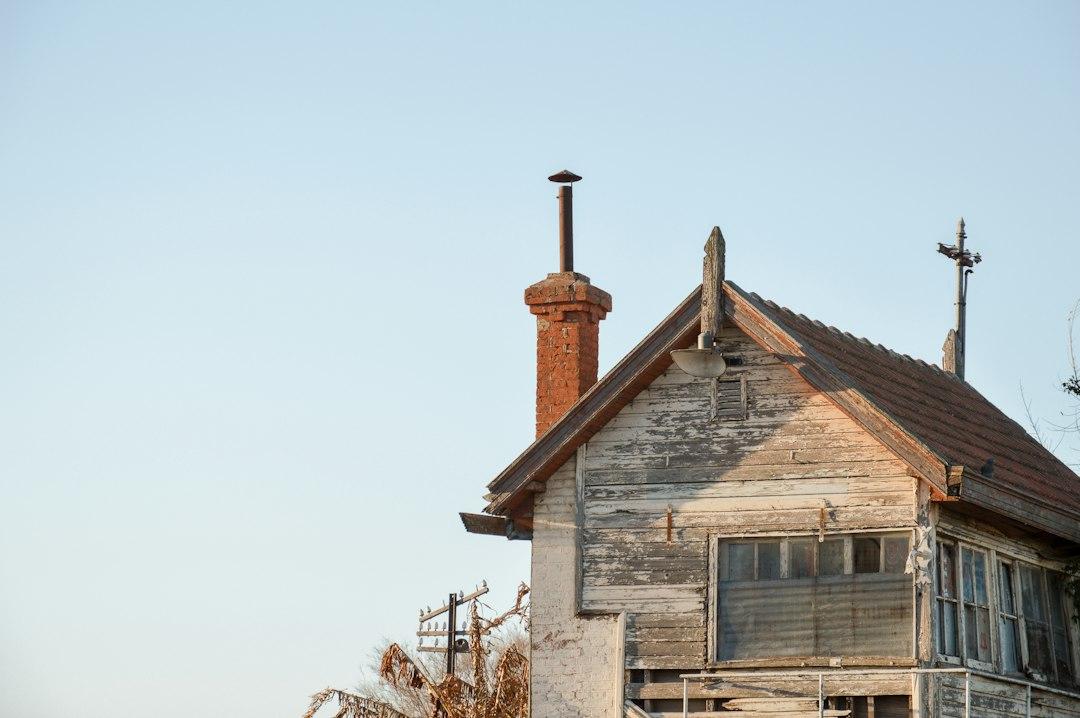
An open flue is a funnel. Rain falls straight down it, soaks the smoke chamber and lands on the damper and in the firebox. Caps also rust out. On the coast, a galvanized cap can turn into a lace of rust in a handful of years, and once the lid has holes, it may as well not be there.
Clues: water in the firebox right after rain, a rusty or stuck damper, a smell of wet soot, rust streaks running down the crown from the cap, and animals nesting in the flue. A cap is often the simplest leak fix, and an installed cap is quoted after we measure. Size and flue count set the price.
Entry point 3: The flashing
Flashing seals the joint where the chimney meets the roof. When it fails, water runs down the outside of the chimney under the roofing and into the attic.
Clues: a stain right beside the chimney on the ceiling or high on the wall, worse after windy storms, damp framing next to the chimney in the attic, cracked or lifted sealant along the roofline, and rust on the metal. We cover this one in detail in five signs your flashing failed.
Entry point 4: The brick and mortar
Brick and mortar are porous. Sound masonry sheds most of the water that hits it, but worn mortar joints and spalled brick soak it up and pass it inward. On a chimney where one face has taken years of ocean wind, enough water can travel through the brick to stain the inside wall.
Clues: damp patches on the chimney breast inside the house, paint bubbling on the chimney wall, white stains on the outside brick, sandy or recessed mortar joints, and flaking brick faces. See our post on spalling brick for the stages.
Entry point 5: Condensation and the flue itself
Not every damp chimney is a rain leak. A gas appliance vented into an oversized, unlined masonry flue can produce water vapor that condenses on the cold flue walls and runs down, staining the brick and rusting the damper. Cracked flue tiles also let water that has entered from above move sideways into the brick. These show up in odd places and often need a camera to confirm.
Clues: staining that appears even in dry weather, especially when a gas fireplace or furnace has been running, and dampness at the base of the flue. A Level 2 inspection is the way to see inside.
Why the stain lies
Water rarely drips straight down from where it enters. It runs along framing, follows the outside of the flue, wicks through brick and pools on ledges before it shows up somewhere you can see. A crown leak can look like a flashing leak. A roof valley leak several feet away can run to the chimney and look like either. That is why the stain on the ceiling is only a starting point.
How we trace a leak
We start by asking about the pattern. Does it leak in every rain or only in wind? Only from one direction? Does the firebox get wet, or only the ceiling? Has anything been done to the roof or chimney recently? Then we inspect from the top down: the cap, the crown, the brick and mortar, the flashing and the roofing around the chimney, then the attic and the inside of the firebox and smoke chamber.
When the inspection points clearly at one source, we show you photos and explain why. When it does not, we water-test. We wet one area at a time, starting at the lowest point and working up, while someone watches inside. It is slow, but it is the only way to be certain, and it is far cheaper than fixing three things in the hope that one of them was the leak.
The repair order
Once we know the source, we fix from the top down, because water does not respect our repair schedule. The cap and crown come first, then the flashing, then the masonry, then a breathable water repellent on the brick. Inside, we repair whatever the water has damaged, such as a rusted damper or a smoke chamber with washed-out mortar. Each repair is quoted in writing before work begins.
What waiting costs
A small leak in October becomes a wet framing problem by March. Water that sits in brick through a winter spalls the faces off. Water that reaches the framing around the chimney rots it, and water in insulation grows mold. The repair that would have been a crown seal or a new cap grows into masonry, carpentry and drywall work. If you saw a new stain after the last storm, the time to trace it is before the next one. Tell us what you are seeing and describe it when we call.
Same Sign on Your Own Chimney?
Birchwood follows the sign back to the part that failed, photographs it and writes up the mend before any work. Visits go out from Palos Verdes Estates to Rolling Hills Estates, Rancho Palos Verdes, Torrance and the beach cities.